**2026 February Mid-Term Trend Report**
**2026 February Mid-Term Trend Report**
EGTI (EGWT) — Structural Trend Assessment
Executive Summary
The mid-term trend has not entered a structural breakdown, but the market has transitioned away from a momentum-driven advance into a time-dependent consolidation phase.
Risk conditions remain contained, participation has cooled from recent extremes, and positioning is elevated but no longer expanding aggressively. This combination suggests range persistence rather than directional acceleration.
EGTI status: Trend intact, regime shifted
Focus: Time over price
Macro Context — The “Warsh Trade” Repricing
Markets are currently digesting a highly confident consensus around the so-called Warsh trade:
USD strength
Pressure across precious metals
Volatility spillover into crypto and high-beta assets
From a structural perspective, this episode is best classified as price repricing under narrative certainty, rather than a regime-level reset.
History consistently shows that markets struggle to sustain directional momentum once consensus becomes one-sided, even when the narrative itself appears logical.
The current environment reflects uncertainty resolution in price, but not yet in structure.
Structural Assessment — EGTI Framework
1. EG Risk Structure Level
Risk conditions remain contained.
Volatility behavior confirms stabilization rather than escalation.
This rules out a systemic risk phase and keeps the broader trend framework intact.
Interpretation:
Risk no longer drives upside acceleration, but also does not justify downside regime change.
2. EG Participation Structure Level
Participation has cooled from recent peaks, moving away from emotional extremes.
Importantly, participation contraction is orderly, not panic-driven.
Interpretations
This supports consolidation rather than trend failure.
3. EG Positioning Structure Level
Positioning remains elevated within the current regime, but shows signs of saturation rather than expansion.
Capital deployment is no longer chasing momentum, shifting the market from price discovery to time absorption.
Interpretation:
Upside requires time to rebuild capacity; downside is limited without risk escalation.
Cross-Structure Confirmation
The interaction between positioning and risk conditions indicates increasing fragility for aggressive continuation, but insufficient pressure for structural breakdown.
This configuration historically resolves through:
Range compression
Rotational movement
Time-based normalization
rather than directional collapse.
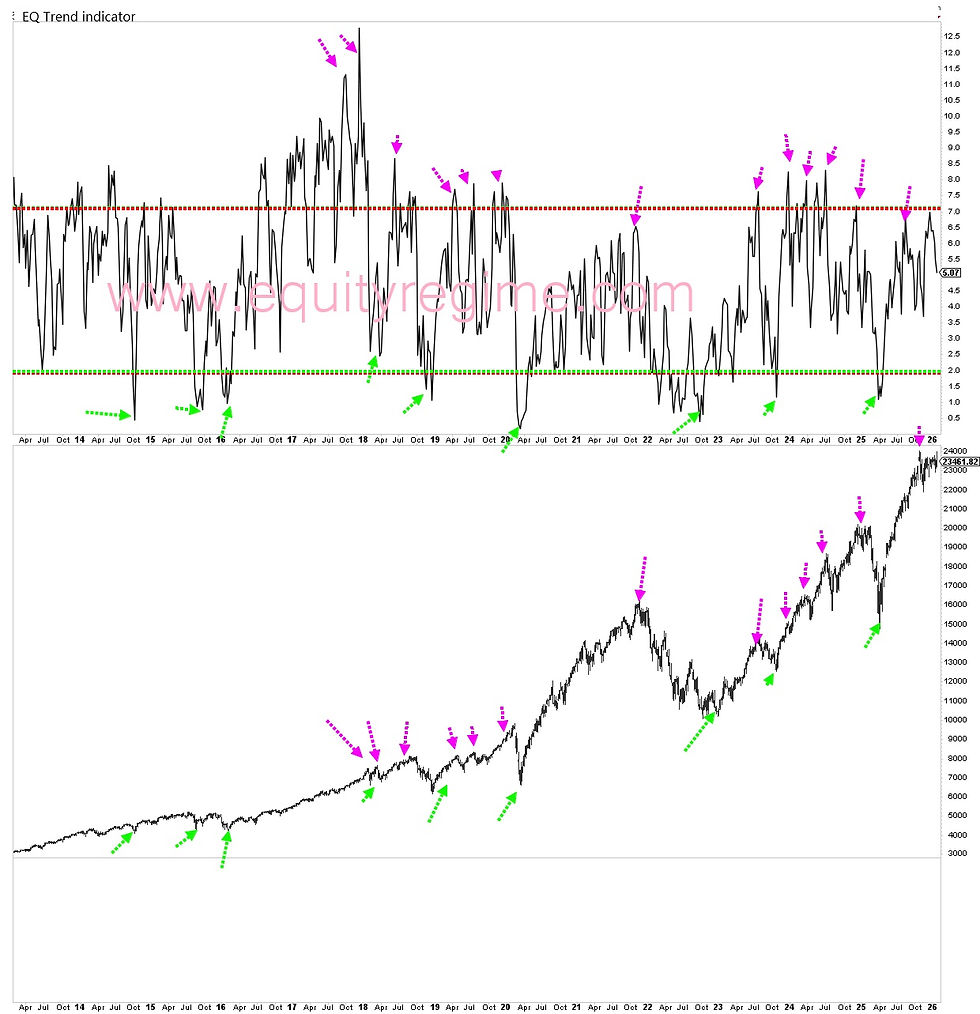
EGTI Trend Transition Marker
The recent EGTI trend transition was confirmed through composite structural assessment.
The accompanying chart serves solely as a visual marker of the transition, not as the trigger.
Conclusion precedes visualization. Structure precedes signal.
Forward Outlook — What This Phase Is (and Is Not)
This phase is:
✔ A consolidation driven by time, not fear
✔ A digestion of prior gains
✔ A regime where signals matter more than narratives
This phase is not:
✖ A structural top
✖ A volatility expansion phase
✖ A trend failure
Markets in this configuration tend to frustrate both bulls and bears, rewarding patience and discipline.
Final Verdict
We do not predict price. We assess structure.
As of February 2026:
Trend: Intact
Regime: Transitioned
Bias: Neutral-constructive
Strategy: Respect range, wait for confirmation
EGTI remains the governing signal. Until structure changes, conclusions do not.

Technical Exhibit: The EGTI Structural Matrix
“Structure Precedes Signal”
The following analytics provide the quantitative foundation for our February 2026 Mid-Term Outlook. They are presented as structural exhibits, not as standalone trading signals.
I. EG Risk Structure Level
Internal Risk Framework
Assessment
The risk-of-risk ratio is currently oscillating within a descending compression channel, with the latest reading near 0.163.Volatility dynamics remain contained, with no evidence of second-order expansion.
Significance
This behavior is inconsistent with the volatility spillover typically observed during structural crashes.The current drawdown therefore qualifies as a Price Recalibration, not a Regime Reset.
II. EG Participation Structure Level
Sentiment Dynamics
Assessment
Following emotional extremes observed late last year, participation has normalized to a neutral-negative reading of −13.60.
Significance
This orderly retracement reflects speculative excess being absorbed without panic liquidation.Such behavior historically supports range persistence, rather than trend failure.
III. EG Positioning Structure Level
Capital Saturation
Assessment
Institutional exposure remains at a high-plateau level (88.46), indicating that the prior momentum phase has reached deployment saturation.
Significance
While the primary trend remains intact, the absence of fresh marginal buyers introduces a natural ceiling.This shifts market behavior from price acceleration to time-based consolidation.
IV. EG Positioning–Risk Interaction
Regime Multiplier
Assessment
This composite interaction metric, currently at 5.07, monitors the tension between elevated positioning and stabilized risk conditions.
Significance
Historically, this configuration resolves through range compression and rotational digestion, not through directional collapse, as the structural floor remains supported by the absence of systemic risk escalation.
Final Synthesis
Taken together, these four structural pillars confirm that while the market may feel heavy, the underlying Equity Regime remains resilient.
We are currently in a phase of Uncertainty Resolution, where:
Risk is contained
Participation is normalized
Positioning is saturated but stable
In such regimes, the system rewards patience and structure awareness, rather than aggressive directional positioning.
Structure precedes signal. Time precedes price.
Disclaimer
This report is for informational and educational purposes only.It does not constitute investment advice, a solicitation, or a recommendation to buy or sell any financial instrument.
All views expressed are based on structural analysis frameworks and historical observation.Market conditions can change without notice, and past structural behavior does not guarantee future outcomes.
EGTI signals reflect regime assessment, not price prediction.No specific price targets, timelines, or return expectations are implied.
Readers are responsible for their own investment decisions and risk management.
Equity Regime Market structure, risk tolerance, and regime classification