Capital Structure Map Series #1 :AI–Robotics Expansion Constraints

The real AI–Robotics expansion path is not driven only by models and chips.
It follows a physical constraint chain where each layer enables the next stage of adoption.
Electricity → Compute → Data Infrastructure → Perception → Actuation → Applications
Understanding these layers helps explain where capital flows as AI systems scale.
Key Layers of the AI–Robotics Expansion Chain
Electricity Infrastructure
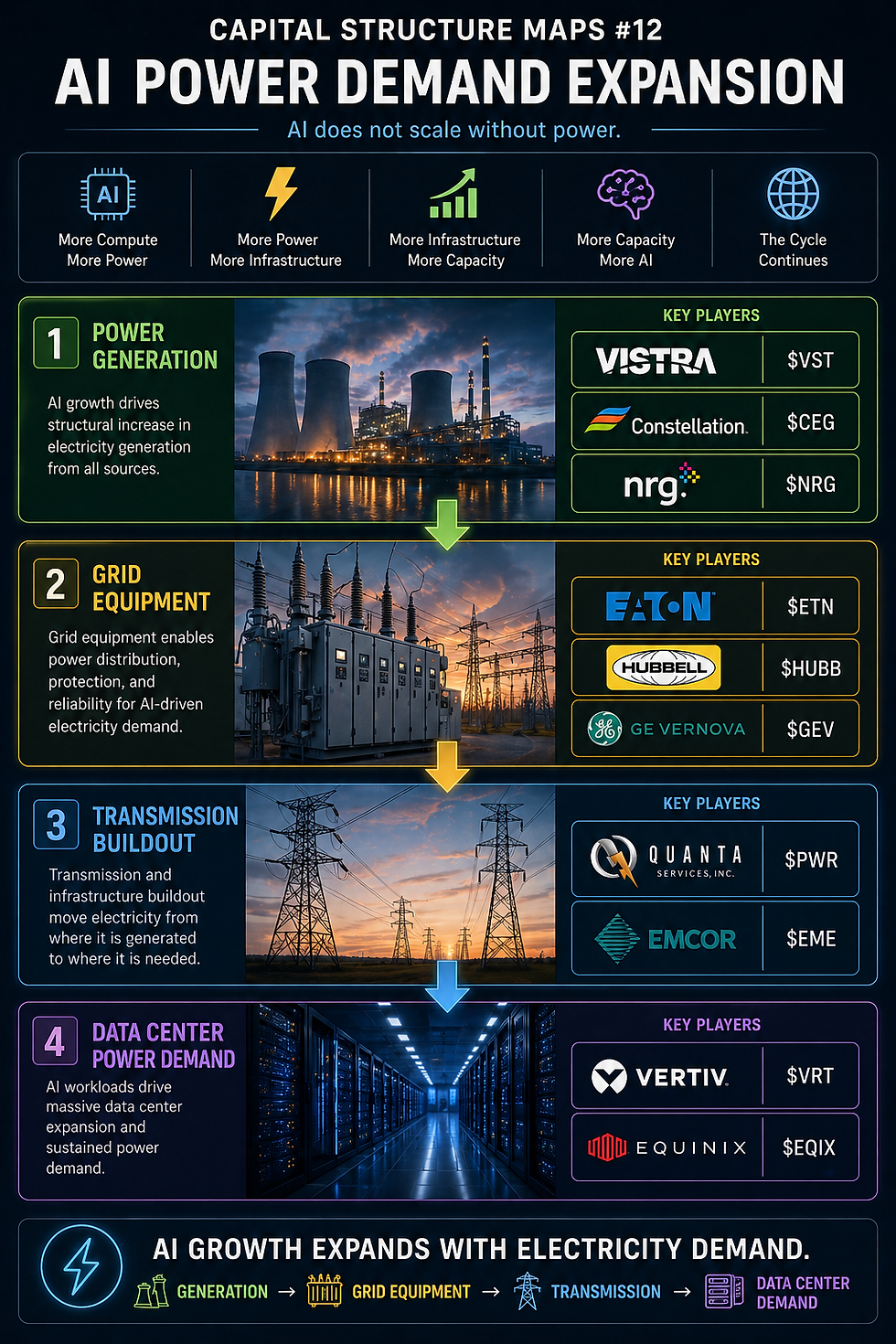
Power generation and grid equipment form the first bottleneck enabling large-scale AI and robotics systems.
$VST $CEG $GEV $ETN
Compute & AI Processing
GPUs and accelerators provide the computational backbone for AI models and robotic “brains”.
$NVDA $AMD $AVGO
Data & Network Infrastructure
Data centers, connectivity, and networking hardware enable large-scale model training and deployment.
$ANET $VRT $EQIX
Perception Systems
Sensors, cameras, lidar, and perception stacks allow machines to interpret the physical world.
$MBLY $APTV $SONY
Motion & Actuation
Motors, bearings, actuators, and mechanical systems translate intelligence into physical movement.
$RRX $TKR $MGA
Applications
Autonomous systems, logistics, and robotics platforms deploy the full stack into real-world use.
$TSLA $AMZN $ABB
Structural Insight
AI and robotics are not just software cycles.
They represent a capital-intensive physical expansion cycle, where progress depends on electricity, compute capacity, infrastructure build-out, and industrial hardware.
About This Series
Capital Structure Maps is an ongoing research series examining the structural foundations behind major technology and industrial cycles.
Each map outlines the constraint chains and capital pathways that connect infrastructure, semiconductors, energy systems, automation, and end-market applications.
The goal is to provide a structural view of where capital must flow as new technologies scale into the real economy.
A new map will be published weekly as part of the Equity Regime research framework.