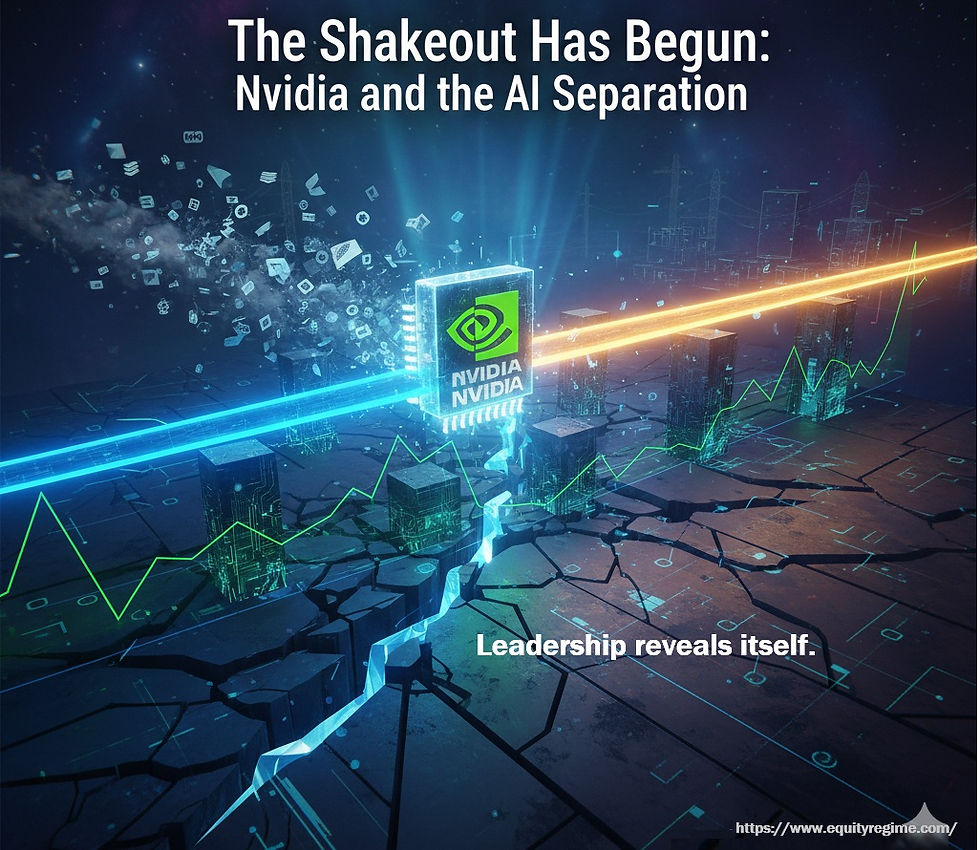
The Shakeout Has Begun: Nvidia and the AI Separation
Updated: Feb 10
Editor’s Note:
This article is part of the Equity Regime AI Structural Series, an ongoing research stream examining how artificial intelligence is rewriting industrial structures, shifting control layers, and redistributing pricing power across sectors.
The AI Investment Cycle Is Not Ending — It Is Maturing
Every transformative technology follows a recognizable progression. The early phase is dominated by speculation, when capital rewards narratives faster than economics. Throughout much of 2023 and 2024, association with AI alone was often sufficient to attract investment.
Markets, however, rarely remain in that phase.
The cycle is now advancing into its second stage: separation.
The central question is no longer who can reference AI, but who can extract durable economic value from it. At this stage, volatility is not noise — it is the mechanism through which markets reprice business models in real time. Companies built on fragile premises are adjusting with notable speed, while structural leaders are quietly reinforcing their foundations beneath the turbulence.
Separation is not the end of enthusiasm.
It is the beginning of economic gravity.
The Repricing of the Software Layer
Early pressure is emerging across segments of the traditional software ecosystem.
For decades, enterprise software scaled alongside human labor: more employees meant more licenses, more seats, and predictable renewal growth. Embedded within that model was a largely unchallenged assumption — that organizations would continue expanding their workforces.
Artificial intelligence challenges that premise directly.
Automation compresses headcount. Certain workflows bypass traditional interfaces entirely, migrating toward autonomous execution. When the path of demand shifts, revenue architectures must inevitably adjust.
What appears cyclical on the surface increasingly resembles something deeper — an architectural reconfiguration of the application layer.
Transitions of this nature rarely occur smoothly.
Upstream Certainty: Nvidia’s Structural Position
While application-layer companies continue searching for durable monetization, certainty appears to be migrating upstream.
Regardless of which business models ultimately prevail, AI cannot function without a foundational constraint: compute is non-substitutable. Compute, memory, power, and data now form the industrial substrate of the emerging intelligence economy — and Nvidia sits near the center of that stack.
Debates surrounding valuation, institutional positioning, and the durability of capital spending have been persistent. Yet market behavior often reveals more than commentary.
In recent months, Nvidia has not exhibited classic distribution. Instead, it has traded sideways within an elevated range, allowing ownership to rotate without forcing a structural repricing lower.
This is not fragility.
It is high-level acceptance — the market establishing consensus at a higher valuation regime.
Weak assets typically resolve uncertainty through price declines. Leaders more often resolve uncertainty through time.
When doubt intensifies and capital chooses to remain, replacement risk is implicitly being repriced.
Nvidia may therefore be undergoing more than consolidation. It may be experiencing an identity transition — from a high-growth technology company toward recognition as a foundational infrastructure provider for the AI era.
Compute markets are increasingly pricing it that way.
Infrastructure Is Now Being Priced
A less visible — yet increasingly decisive — signal is emerging beneath the equity surface: the pricing of compute itself.
During much of 2025, H100 rental rates drifted lower, briefly reinforcing the narrative that AI infrastructure might be approaching oversupply. The interpretation proved premature.
As agentic workloads accelerated toward year-end, demand shifted from episodic model training to persistent inference capacity. Compute was no longer consumed merely as a project input; it was becoming operational infrastructure.
Rental pricing stabilized — and then reversed.
What followed is particularly revealing: Nvidia did not weaken as compute costs firmed. Instead, equity and infrastructure pricing began advancing in tandem.
This synchronization suggests a deeper regime transition.
The market is no longer valuing Nvidia solely on technological leadership or narrative momentum. Increasingly, it is responding to a more fundamental constraint — capacity scarcity.
When a critical input stops getting cheaper yet demand remains intact, markets rarely interpret the signal as fragility. More often, they recognize necessity.
Compute pricing is beginning to exert a form of economic gravity across the AI ecosystem — quietly anchoring expectations around durability rather than speculation.
Infrastructure cycles are not defined by abundance.
They are defined by what the system cannot function without.

Strategic Capex and the Logic of Positioning
Another signal is emerging from the spending trajectories of the world’s largest technology companies.
Alphabet, Amazon, Meta, and Microsoft are not retrenching. They are sustaining — and in several cases accelerating — investment. Increasingly, this spending appears strategic rather than purely demand-driven.
At technological inflection points, capital expenditure often functions as competitive positioning. When infrastructure determines future control layers, waiting carries greater risk than building early.
Strategic capex tends to persist longer than expected.
And in infrastructure cycles, certainty typically concentrates upstream — not among businesses still validating their economic models downstream.
None of this eliminates risk. Infrastructure buildouts can overshoot, and spending cycles can pause if downstream returns lag. Yet technological revolutions rarely wait for perfect monetization before scaling.
Railroads were laid before traffic materialized.
Data centers expanded before cloud profitability was fully visible.
Infrastructure is built ahead of certainty — not after it.
Separation as a Structural Process
Recent turbulence may therefore be conveying a subtle but unmistakable message:
The divide between winners and losers in the AI era is no longer theoretical. It is beginning to materialize.
As capital quietly takes sides beneath the noise, the assets that resist migrating lower during periods of maximum uncertainty often become the anchors of portfolios in the decade that follows.
The shakeout is not the end of the cycle.
It is the mechanism through which leadership becomes visible.
As markets transition from narrative-driven enthusiasm toward cash-flow repricing, the critical question becomes unavoidable:
Are assets aligning with structural capital — or drifting away from it?
Structural Conclusion
The AI cycle is not fading.
It is industrializing.
When compute stops getting cheaper, artificial intelligence stops behaving like a technological theme and begins behaving like infrastructure.
And infrastructure cycles are governed not by excitement — but by scarcity.
The separation has begun.
About Equity Regime
Equity Regime is an independent research platform dedicated to mapping structural shifts across markets, technology, and capital cycles.
Our focus is not on predicting daily price movements, but on identifying regime transitions — periods when consensus narratives lag underlying reality and long-term repricing quietly begins.
In an environment dominated by noise, our objective is simple:
Detect the shift before it becomes obvious.