EGTI Weekly Trend Indicator — Updated
Updated: Feb 19
Equity Regime stock market mid-term Trend Indicator

Market State: Pricing Re-calibration
Regime: Uptrend Intact
Risk Structure: Contained Liquidity
Verdict: Consolidation within expansion.
No structural downside trigger。
Founder’s Note — EGTI Weekly Context
This week’s EGTI update confirms that market structure remains intact despite ongoing price turbulence. The current phase is best characterized as pricing re-calibration within an established uptrend, rather than the onset of a regime transition.
Recent liquidity telemetry does not support tightening conditions. Treasury cash balances remain elevated but have not exhibited acceleration consistent with systemic drain. Bank reserves continue to hold above the structural floor, while funding markets show no signs of stress. At the same time, elevated dark-pool absorption indicates that institutional capital is actively mitigating downside volatility.
The observable range-bound price behavior should therefore be interpreted as a function of positioning friction and sector rotation, not distribution. Internal capital reallocation—particularly between growth-heavy segments and broader NYSE constituents—has introduced short-term index stagnation while reinforcing overall liquidity sponsorship.
From a structural perspective, the absence of synchronized deterioration across liquidity, absorption, and positioning metrics argues against a downside regime shift. Pullbacks remain absorption-driven, and volatility is being moderated by positive gamma dynamics and stable funding conditions.
The base case remains unchanged: consolidation within expansion. Reflex rallies and range behavior are expected to persist as the market processes valuation adjustments and rotation effects, but the broader uptrend retains sponsorship.
In practical terms, turbulence without contraction should be viewed as time-based consolidation rather than structural weakening. Until liquidity withdrawal, absorption failure, or positioning destabilization emerges in combination, downside scenarios lack sufficient confirmation.
The current environment continues to favor a disciplined interpretation: the market is stabilizing through internal repricing while maintaining an intact structural foundation.
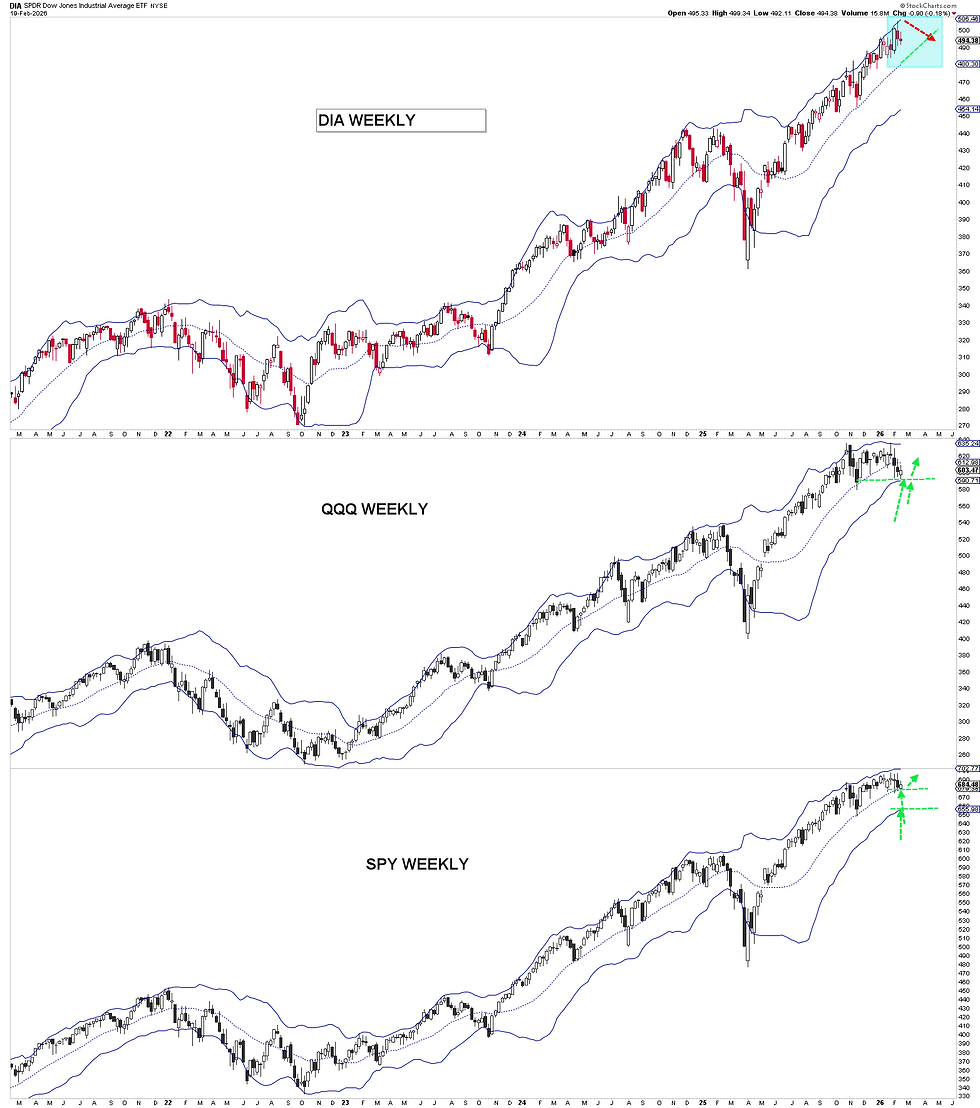
As the chart illustrates, the Dow continues to exhibit relative strength while QQQ remains range-bound near its upper channel. This is not a structural breakdown. It reflects a rotation phase in which capital is migrating from concentrated growth exposure toward a broader equity base.
Such transitions often compress index performance in the short term, creating the appearance of stagnation while strengthening underlying sponsorship. With absorption intact and funding conditions stable, the probability of distribution-driven downside remains limited.
In this context, the divergence between $DIA, $QQQ, and $SPY should be interpreted as a rotation gap inside expansion — a transitional phase that typically precedes renewed trend synchronization rather than market collapse.
Equity Regime Intelligence Suite — Release Framework (EST)
The Equity Regime system operates on a structured publication cycle designed to separate trend diagnosis, timing signals, and liquidity monitoring across multiple time horizons.
EGTI — Trend Regime Signal
Released every Friday before market open.
Defines the prevailing market structure and directional bias.
EGTB — Top & Bottom Timing Signal
Released every Monday before market open. Identifies volatility-defined inflection points.
EG Market Monthly Report
Published on the first weekend of each month. Provides a macro-structural synthesis of liquidity, positioning, and participation.
LRM-14 — Liquidity Regime Matrix
Updated every weekend. Tracks systemic liquidity conditions shaping the risk environment.
