Equity Regime Trend Weekly Update — February 5, 2026
Updated: Feb 8

Core Thesis: Structural Resilience Amid Tactical Noise
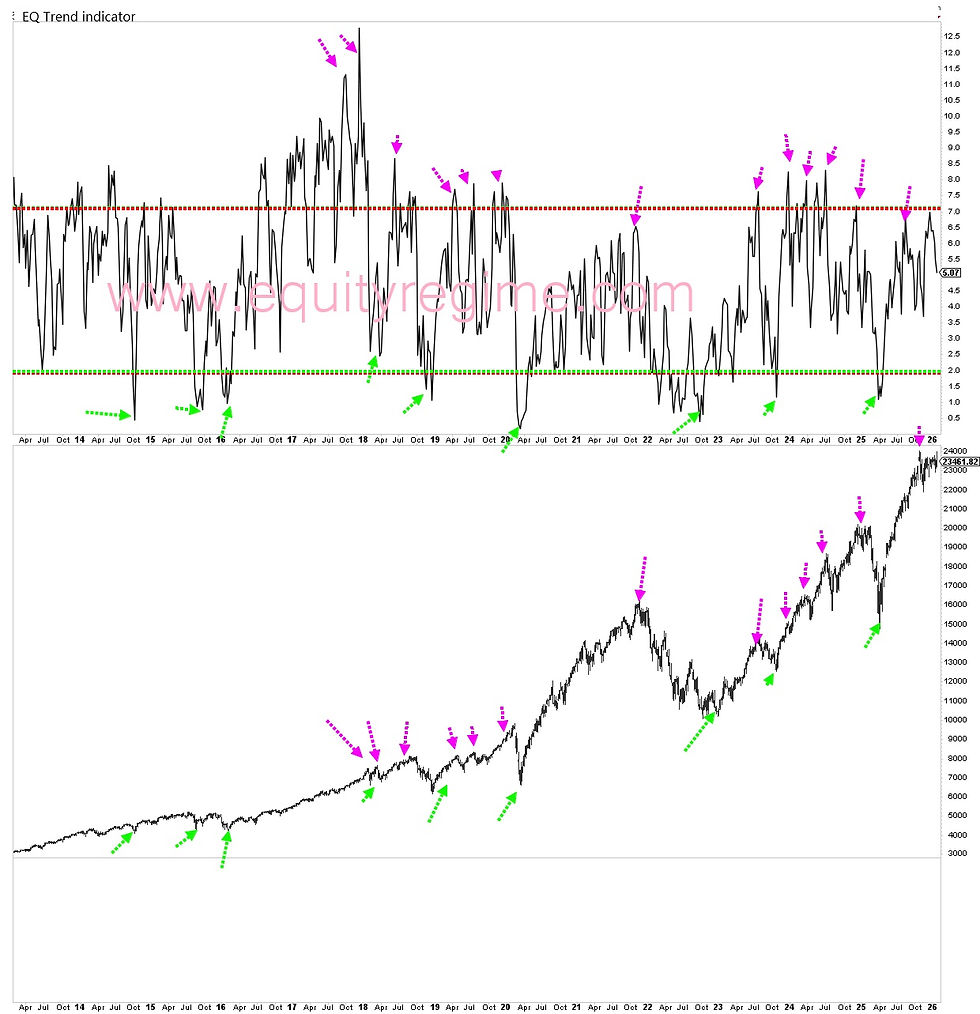
Despite a recent pickup in daily volatility, our proprietary Equity Regime Trend Indicator (EGTI) continues to confirm that the structural bull market remains intact.
While short-term turbulence has triggered defensive daily signals, the higher-confidence weekly framework suggests that the market is operating within a consolidation phase inside an ongoing uptrend — rather than undergoing structural deterioration.
Multi-Timeframe Signal Assessment
The defining feature of the current environment is the divergence between short-term momentum disturbances and long-term breadth stability — a hallmark of durable bull regimes.
Intermediate Trend (Weekly): Structure Unchanged
Our primary trend signal remains positive, indicating that recent volatility has not compromised the underlying market architecture.
Market Breadth:Cumulative NAHL/QQQ and NYHL/SPY measures continue to hold above their long-term moving average support, confirming that participation remains healthy even as headline indices encounter pressure.
This reflects a classic condition of:
price adjustment — not structural weakening.
Daily Signals: Entering a Volatility Floor Zone
Our tactical indicator, EGTB (EG Top & Bottom Signal), has triggered an extreme volatility alert, with the VXN reaching levels that have historically aligned with localized market bottoms.
Qualitative Interpretation:
The current episode is best understood as a repricing event,not a structural breakdown in market function.
The market is likely at — or approaching — the lower boundary of this volatility range.
The Four-Year Expansion Framework & Breadth Confirmation
Following the 2022 drawdown — formally classified within the Equity Regime framework as the Systemic Valuation Reset — and the early-2025 correction, the present structure aligns with the mid-phase of a four-year expansion cycle.
Historically, when markets experience two drawdowns exceeding 15% within roughly a two-year window, the subsequent trend persistence often extends for approximately twice the duration of the adjustment period.
This phase typically resolves excess through:
time-based consolidation
moderate pullbacks
sector rotation rather than systemic decline
Weighted internal measures, incorporating sentiment, positioning, and participation, suggest that the market is actively digesting prior repricing pressures while cumulative breadth remains intact.
Put simply:
Capital is rotating — not exiting.
Forward Outlook and Strategic Implications
The rapid decline observed in select sectors appears increasingly mature, with momentum approaching exhaustion levels that historically precede stabilization.
Importantly, the weekly trend signal has not issued a structural risk warning.
The broader market remains characterized by:
range-bound consolidation with an upward directional bias.
We do not forecast price targets.
We identify risk structures and time windows.
Equity Regime Trend Verdict
Intermediate Trend: UptrendMarket State: ConsolidationDirectional Bias: HigherStructural Risk: Not Present
Final Interpretation
Volatility inside a trend is maintenance — not destruction.
As long as breadth continues to recover and positioning avoids destabilizing extremes, the path of least resistance remains higher.
The current market is not fragile.
It is maturing.
And mature bull markets typically advance with greater rotation, higher tactical volatility, and periodic drawdowns — yet remain structurally supported.
Regime Status: Structurally Supported Bull with Tactical Volatility
Equity Regime
A framework dedicated to identifying market structure and regime shifts through risk tolerance.
The EQ Trend Indicator (EQTI) evaluates structural conditions rather than price direction, enabling earlier recognition of transitions in the market environment.
It defines regimes — not trades.