**Bitcoin’s Coming of Age: From Chaotic Drift to Gravitational Order**
Updated: Feb 7

Introduction — Chaos, or an Invisible Order?
To many investors, Bitcoin appears untamable — an asset defined by violent price swings and seemingly random cycles. Unlike equities, it is often dismissed as lacking structure, discipline, or trend persistence.
Yet when observed across longer time horizons — through the structural lens of the Equity Regime framework — a very different picture emerges.
Bitcoin is not behaving like a chaotic instrument.
It is undergoing a transition — from speculative disorder toward structural maturity.
What appears as turbulence may, in fact, be the visible surface of a deeper reorganization in how the asset is owned, priced, and integrated into global capital markets.
This is not merely statistical normalization.
It is the reconstruction of market logic.
I. The 200-Week Moving Average — Bitcoin’s Structural Cost Anchor
Since roughly 2015, Bitcoin has traded within an increasingly coherent long-duration uptrend. At the center of this evolution lies a powerful gravitational reference point: the 200-week moving average (200WMA).
Rather than acting as a technical “line,” the 200WMA has gradually emerged as the market’s long-duration cost anchor — a zone where long-horizon capital historically demonstrates willingness to absorb supply.
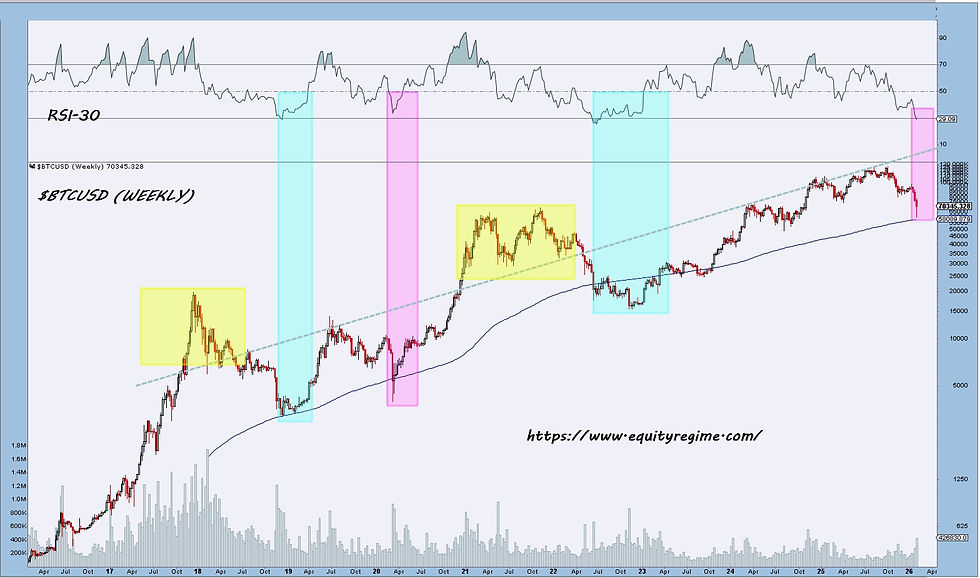
Across multiple cycles — the 2018 crypto winter, the 2020 liquidity shock, and the 2022 deleveraging cascade — price repeatedly found equilibrium near this region.
This persistence is not coincidence.
It reflects the growing presence of durable holders and capital with longer investment horizons.
Recurring Rhythm
History shows that when weekly RSI approaches deeply oversold territory near this structural anchor, price stabilization frequently follows.
This does not imply mechanical predictability.
Instead, it suggests something far more important:
Bitcoin is no longer discovering price in a vacuum —it is oscillating around a developing center of gravity.
Volatility, therefore, increasingly represents distance from equilibrium, not randomness.
II. The Eccentricity Principle — Measuring Distance from Gravity
At the core of this framework is a simple but powerful concept:
Eccentricity — the degree to which price deviates from its long-duration cost anchor.
This distance helps explain why some drawdowns resolve quickly while others demand prolonged structural repair.
High Eccentricity → Complex Bottom Formation
When price expands excessively away from the 200WMA — as observed during late-cycle speculative phases — leverage builds, unrealized profits concentrate, and positioning becomes fragile.
Subsequent declines tend to trigger cascading liquidations, forcing the market into extended consolidation as ownership redistributes.
The bottom, in such environments, is rarely immediate. It is constructed.
Moderate Eccentricity → Faster Repricing
By contrast, when declines occur without extreme prior displacement from the anchor, the market often requires less structural healing.
Selling pressure encounters long-duration demand sooner, allowing price to re-approach equilibrium more efficiently.
The recent decline appears consistent with this latter dynamic — a gravitational pull rather than a structural fracture.
This interpretation does not confirm a cycle low. Daily structures may still require secondary validation.
But the character of the move suggests repricing, not regime failure.
III. Institutional Absorption — From Speculative Frontier to Macro Asset
Bitcoin’s volatility today should not be mistaken for immaturity alone. Nearly every major financial asset has traversed a similar early phase — marked by fragmented ownership, shallow liquidity, and dramatic price discovery.
What distinguishes Bitcoin now is the transformation of its liquidity function.
The expansion of institutional access — particularly through regulated vehicles such as spot ETFs — is not eliminating volatility.
It is synchronizing Bitcoin with global capital flows.
Institutional participation deepens order books, accelerates arbitrage, and enhances risk transfer mechanisms. Over time, this shifts the asset’s behavior from isolated speculation toward macro sensitivity.
Bitcoin is increasingly reacting not just to internal narratives, but to:
global liquidity conditions
real interest rates
risk appetite
monetary expectations
In short, it is being absorbed into the architecture of modern finance.
This marks a profound transition:
from alternative asset → emerging macro barometer.
Structural Implication — Volatility as Reversion, Not Disorder
As long as the long-duration cost anchor continues to slope upward, sharp drawdowns are more likely to represent gravitational reversion than structural collapse.
This does not eliminate risk.
Anchors persist — until regimes change.
A sustained breakdown beneath this equilibrium would signal not a correction, but a redefinition of the market’s center of gravity.
Frameworks must always allow for structural override.
But absent such evidence, volatility should be interpreted with context rather than fear.
Conclusion — Defining Turbulence Before It Defines You
The Equity Regime framework does not attempt to forecast every short-term fluctuation. Its purpose is higher: to determine the nature of instability when it emerges.
Is the market undergoing a temporary repricing —or signaling structural decay?
Bitcoin is gradually shedding the behavioral signature of a purely speculative instrument. Ownership is lengthening. Capital is stabilizing. Gravity is forming.
For investors capable of recognizing this transition, revisits toward the long-duration anchor are not necessarily moments of panic.
They may instead represent the mechanism through which an asset matures.
Bitcoin is not becoming less volatile by accident.
It is finding its center of gravity.
Jenny Lee — Equity Regime February 6, 2026