Broadcom’s $10B Buyback: A Liquidity Defense in the AI Capex Cycle
EG LRM-14 Macro Insight | Liquidity Defense

While parts of the Mag-7 are increasingly absorbed by the escalating AI capital-expenditure race, Broadcom’s latest earnings delivered a different signal to the market.
Alongside strong results and accelerating AI revenue, the company authorized a new $10 billion share repurchase program.
At first glance, this may appear to be a routine capital-return decision. Under the EG LRM-14 liquidity framework, however, the action carries deeper macro implications.
This is not merely financial engineering.
It is a liquidity defense mechanism during a re-pricing cycle.
The Context: AI CapEx Is Reshaping Capital Allocation
The global AI build-out has triggered an unprecedented capital expenditure cycle across hyperscalers and semiconductor suppliers. Major technology firms are committing enormous resources to secure compute capacity, networking infrastructure, and custom silicon.
For many companies, this race has had a direct consequence:
share buybacks are shrinking.
Cash that previously supported equity valuations is now being redirected toward AI infrastructure investments.
In other words, capital is being converted from financial return to strategic expenditure.
Broadcom’s strategy stands in sharp contrast.
Liquidity Defense in a Re-calibration Regime
Within the EG LRM-14 macro framework, the current market environment is best characterized as a Re-calibration regime.
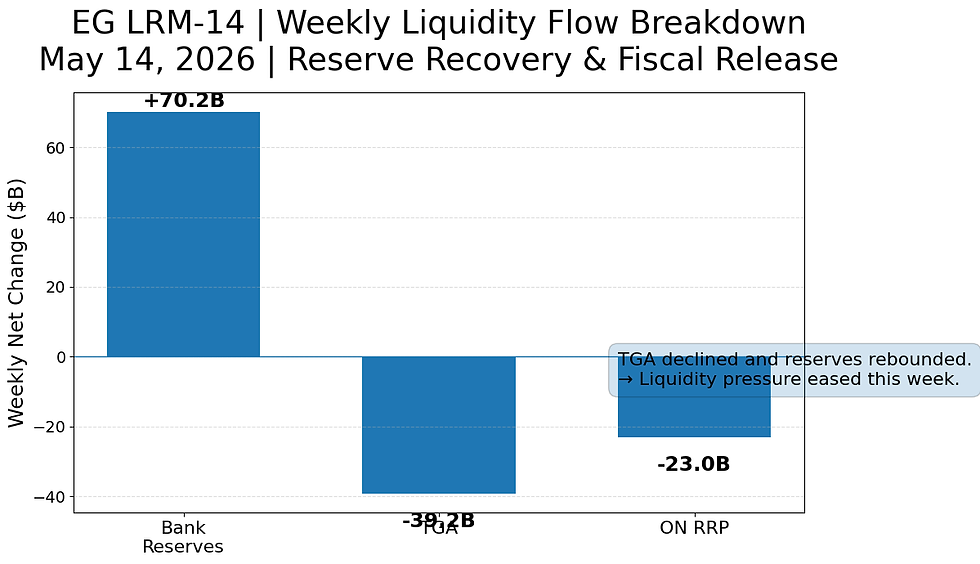
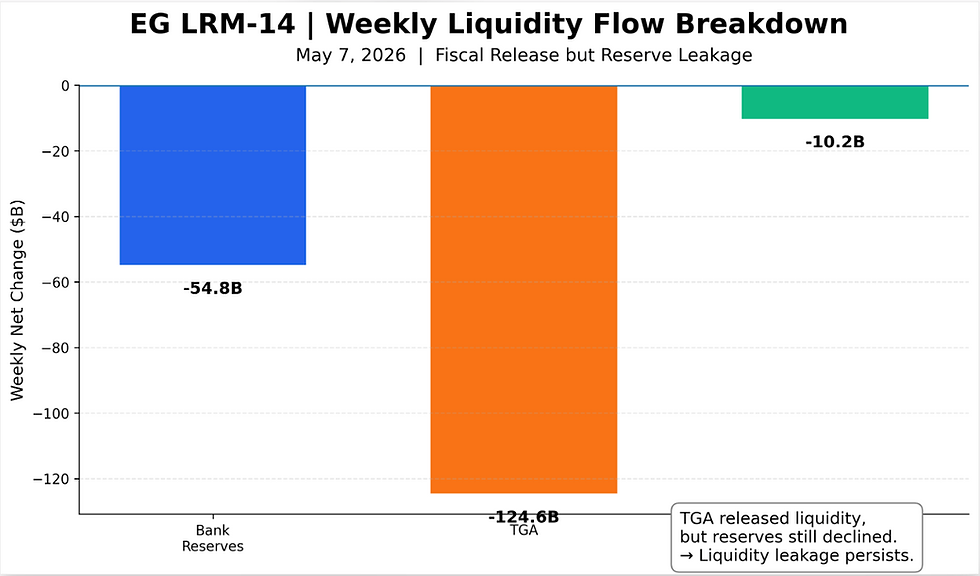
Liquidity is not collapsing, but it is being re-priced and redistributed.
In such an environment, corporate buybacks take on a new function.
They become a way to offset macro liquidity loss rates.
By retiring shares, companies effectively create artificial scarcity in equity supply, counterbalancing tightening financial conditions.
Broadcom’s $10 billion authorization therefore acts as a valuation stabilizer, reinforcing investor confidence in the durability of its cash-flow engine.
Asymmetric Positioning in the AI Ecosystem
Broadcom’s capital strategy also reflects its unique position within the AI value chain.
Many firms in the sector are still paying the entry cost of the AI cycle:
building new data centers
expanding compute infrastructure
committing to multi-year silicon procurement
Broadcom, by contrast, appears to be harvesting the economic upside of that investment wave.
Its AI semiconductor revenue reached $8.4 billion in the latest quarter, and management guided for approximately $10.7 billion next quarter, implying rapid acceleration in hyperscaler demand.
This asymmetry is critical.
It suggests that Broadcom has moved from being a beta growth participant in the AI cycle to becoming a cash-flow fortress with AI elasticity.
The Strategic Logic of Share Reduction
In periods of tightening liquidity, corporate leaders face a fundamental question:
Where is capital most effectively deployed?
For Hock Tan, Broadcom’s CEO, the answer appears clear.
When cash flow is strong and growth visibility remains high, the most attractive acquisition target may be the company’s own equity.
Reducing share count while AI revenue expands creates a powerful financial dynamic:
earnings per share improve structurally
equity scarcity supports valuation multiples
long-term shareholder alignment strengthens
Under conditions where bank reserve volatility and macro uncertainty remain elevated, such balance-sheet discipline becomes a crucial competitive advantage.
Liquidity Hierarchy Inside the AI Trade
Broadcom’s decision also highlights an emerging reality within the AI ecosystem:
not all participants occupy the same liquidity tier.
Some companies remain capital-intensive builders of AI capacity.
Others have already become cash-flow beneficiaries of the infrastructure boom.
This divergence is likely to create a new hierarchy among AI equities—one defined not simply by growth rates, but by the ability to generate distributable cash while the cycle expands.
Conclusion: Capital Strategy in a Liquidity Re-pricing Cycle
Broadcom’s $10 billion buyback authorization is not just a corporate finance announcement.
Within the EG LRM-14 framework, it represents a deliberate response to a changing liquidity regime.
As the market recalibrates around the economics of artificial intelligence, the ultimate winners will not necessarily be the companies that spend the most.
They will be the companies that can convert technological leadership into durable free cash flow—and use that cash flow to reinforce equity scarcity.
In that sense, Broadcom’s latest move is less about returning capital and more about redefining capital strategy in the AI era.
About Equity Regime
Equity Regime is an independent research platform dedicated to mapping structural shifts across markets, technology, and capital cycles.
Our focus is not on predicting daily price movements, but on identifying regime transitions — periods when consensus narratives lag underlying reality and long-term repricing quietly begins.
In an environment dominated by noise, our objective is simple:
Detect the shift before it becomes obvious.