🟢 US Stock Market Top & Bottom Timing Signals (EGTB) Signal Update | May 6, 2026

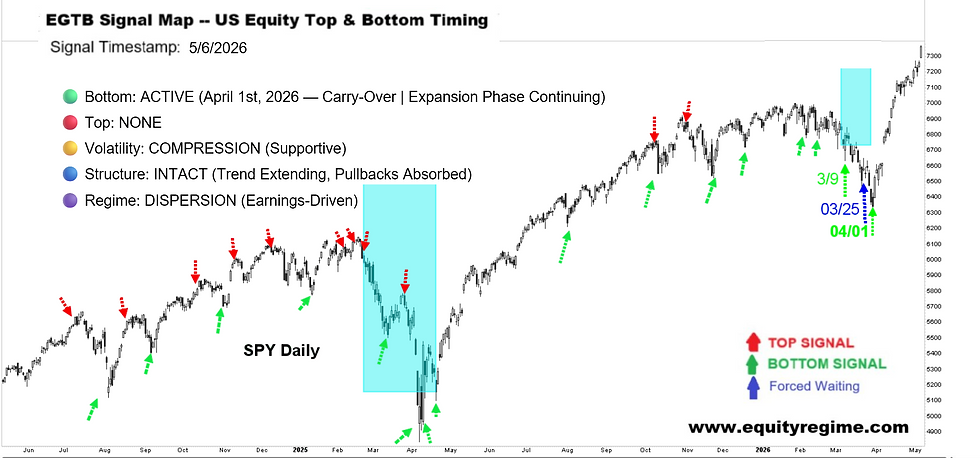
🟢 US Stock Market Top & Bottom Timing Signals (EGTB) Signal Update | May 6, 2026
🟢 Bottom: ACTIVE (Mar 9, 2026 — Carry-Over | Expansion Phase Continuing)
🔴 Top: NONE
🟡 Volatility: COMPRESSION (Supportive)
🔵 Structure: INTACT (Trend Extending, Pullbacks Absorbed)
🟣 Regime: DISPERSION (Earnings-Driven)
Model Notes (Carry-Over) :
US Stock Market Top & Bottom Timing Signals (EGTB) Signal is a timing model, not a trend or valuation framework.
It should be used in conjunction with #EGTI,where EGTI defines the trend, and #EGTB identifies the timing within that structure.
Bottom signals typically evolve through:
volatility compression → consolidation → expansion
A confirmed “Top” requires alignment of:•
Persistent volatility expansion (not event-driven)• Positioning crowding (institutional + retail)•
Credit deterioration
Absence of these = no top confirmation
US Stock Market Top & Bottom Timing Signals (EGTB) Signal Update Context:
No structural change this week.
Volatility compression has progressed further, while dispersion remains the dominant feature post-earnings.
Index-level movement continues to mask underlying expansion.
Bottom line:
Signal unchanged. Expansion remains in progress.
Founder’s Note:
What the market is doing right now is mechanically consistent with a confirmed bottom transitioning into expansion. The signal is not “getting old” — it is progressing.
Volatility compression has now moved from a byproduct to a supportive condition. That shift matters. Early in the cycle, compression reflects uncertainty being absorbed. At this stage, it reflects stability being priced in. That is why pullbacks remain shallow and quickly bid — not because risk is gone, but because it is being structurally contained.
Dispersion remains the dominant regime. Index-level consolidation is not a sign of weakness; it is the surface expression of capital rotating underneath. This is typical of expansion phases, where leadership broadens but does not move in sync.
There is still no alignment for a top.
No persistent volatility expansion.
No positioning saturation
No credit deterioration.
Until those conditions change, the model does not transition.
The key mistake here is to interpret “less explosive” as “ending.”
In reality, this is how trends sustain.


