EGTB Signal Update — Mar 9 2026

🟦 Equity Regime US Stock Market Top and Bottom Timing Signals
🟢 Bottom: ACTIVE (Mar 9)
🔴 Top: NONE
🟡 Volatility exhaustion confirmed
⚪ Credit stabilization detected
Signal Context
The EGTB daily timing model has triggered a new Bottom Signal.
This activation follows confirmation from two internal indicators within the Equity Regime framework:
• EG Water Drop Indicator — a proprietary volatility exhaustion signal derived from a weighted observation of multiple volatility and market-stress measures
• EG Credit Monitor Signal — based on stabilization signals observed in the high-yield credit market, including instruments such as $JNK and $HYG
Historically, when the EG Water Drop Indicator appears together with stabilization detected by the EG Credit Monitor, markets often transition from panic repricing toward a stabilization phase.
Timing Interpretation
The EGTB signal is a timing signal, not a price-level prediction.
Historically, once the signal is triggered:
the market low may already have occurred, or
the final low often forms within the next 1–3 trading days
Therefore, the signal does not imply an immediate V-shaped reversal, nor does it guarantee an instant market rebound.
Instead, it indicates that the downside acceleration phase is likely nearing completion, and the market may be entering a bottoming window.
Model Notes
EGTB (Equity Regime Top & Bottom) is a daily timing model designed to detect potential turning windows in market volatility cycles.
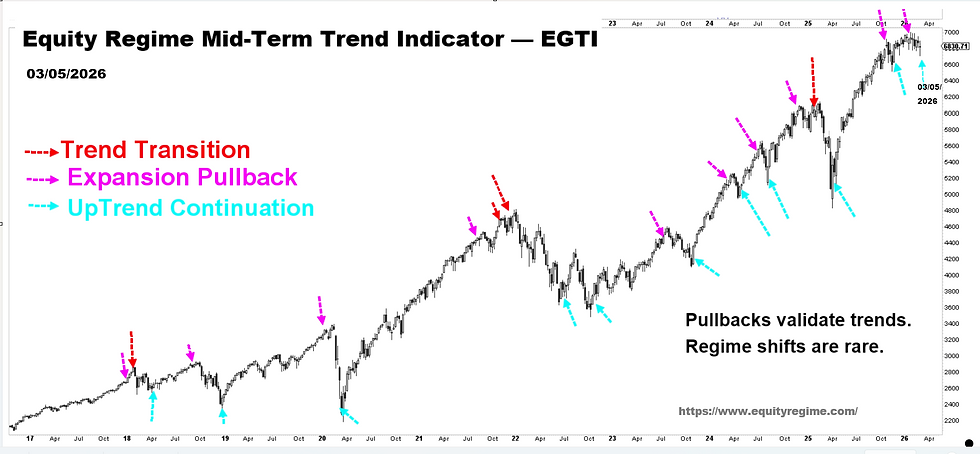
It should be interpreted together with the EGTI weekly trend model, which defines the broader market regime.
Equity Regime Intelligence Suite Update Calendar
#EGTI — Weekly Trend Signal:Every Friday before market open
#EGTB — Timing Signal Update:Every Monday before market open
EG Market Monthly Report:First weekend of each month
#EGLRM-14 (Liquidity Regime Matrix):Every Friday before market open
About Equity Regime
Equity Regime is an independent research platform dedicated to mapping structural shifts across markets, technology, and capital cycles.
Our focus is not on predicting daily price movements, but on identifying regime transitions — periods when consensus narratives lag underlying reality and long-term repricing quietly begins.
In an environment dominated by noise, our objective is simple:
Detect the shift before it becomes obvious.