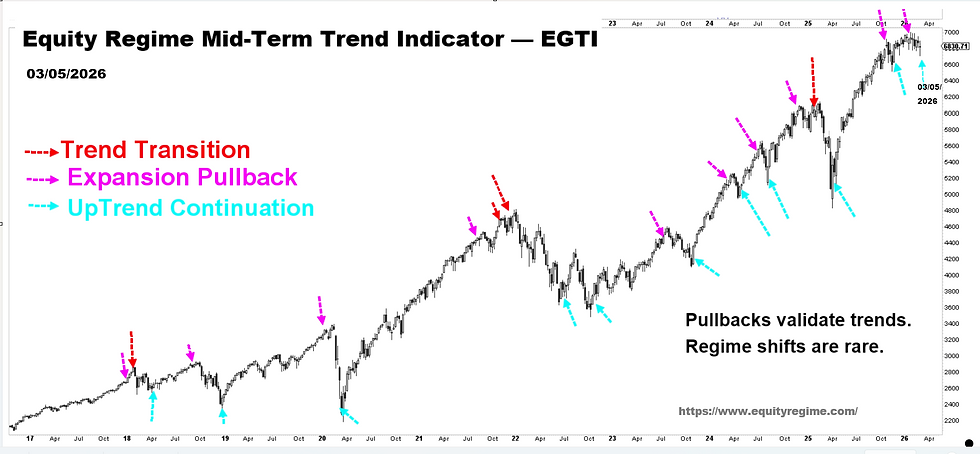
2026 March Mid-Term Trend Monthly Report
Equity Regime
EGTI — Structural Trend Assessment

Executive Summary
The mid-term trend has not entered a structural breakdown, but the market has transitioned away from a momentum-driven advance into a time-dependent consolidation phase.
Risk conditions remain contained, participation has normalized from prior extremes, positioning remains elevated but no longer expanding aggressively, and liquidity conditions remain stable.
This configuration historically resolves through range persistence and rotational digestion, rather than directional acceleration.
EGTI Status: Trend intact, consolidation ongoing
Primary Focus: Time over price
Macro Context — Geopolitical Shock and Volatility Repricing
March opened under a sudden geopolitical volatility shock following the escalation of war-related developments in the Middle East.
Energy markets repriced sharply higher, index volatility increased, and defensive hedging activity rose across major equity benchmarks.
From a structural perspective, however, this episode remains consistent with headline-driven volatility repricing rather than systemic regime change.
Markets are currently adjusting to a short-term uncertainty shock in price, while the broader structural framework remains intact.
Structural Assessment — EGTI Framework
The Equity Regime framework evaluates market structure across four primary dimensions:
Risk
Participation
Positioning
Liquidity
1. EG Risk Structure Level
Risk conditions remain contained rather than escalating.
Volatility behavior continues to reflect compression characteristics, despite the recent short-term increase triggered by geopolitical headlines.
This pattern is inconsistent with the type of volatility spillover typically observed before systemic market breakdowns.
Interpretation
Risk dynamics currently limit aggressive upside continuation, but do not justify a structural bearish regime transition.
2. EG Participation Structure Level
Participation has normalized from prior emotional extremes, moving toward a more neutral sentiment environment.
Importantly, this adjustment has occurred without panic liquidation, indicating that speculative excess is being absorbed gradually rather than through forced deleveraging.
Interpretation
Participation behavior continues to support range consolidation rather than trend failure.
3. EG Positioning Structure Level
Institutional exposure remains elevated but no longer expanding.
Capital deployment appears to have entered a saturation phase, where marginal buying pressure has slowed following the prior momentum advance.
Interpretation
This environment limits immediate upside acceleration while maintaining structural support beneath the market.
4. EG Liquidity Structure Level
Liquidity conditions remain stable but no longer expanding.
Recent Federal Reserve balance sheet dynamics, reverse repo usage, and short-term funding indicators do not signal systemic tightening. However, the liquidity impulse that supported the prior momentum phase has moderated.
Interpretation
Liquidity continues to support structural stability, but does not provide sufficient expansion to sustain rapid price acceleration.
Detailed liquidity analysis is provided in the weekly EG LRM-14 Liquidity Report.
Cross-Structure Confirmation
Taken together, the current structural configuration can be summarized as:
Risk contained
Participation normalized
Positioning elevated
Liquidity stable
Historically, this environment resolves through:
• Range compression• Sector rotation• Time-based normalization
rather than systemic breakdown.
Forward Outlook — What This Phase Is (and Is Not)
This phase represents:
✔ A consolidation driven by time rather than fear
✔ A digestion of prior gains within an intact structural trend
✔ A regime where signals matter more than narratives
This phase is not:
✖ A structural market top
✖ A volatility expansion regime
✖ A trend failure
Markets in this configuration often frustrate both bullish and bearish narratives while rewarding patience and structural discipline.
Final Verdict
We do not predict price. We assess structure.
As of March 2026:
Trend: Intact
Regime: Consolidation
Bias: Neutral-constructive
Strategy: Respect the range. Wait for confirmation.
Until structural conditions change, EGTI remains the governing signal.
Structure precedes signal.
Time precedes price.
Technical Appendix
EGTI Structural Matrix — Structure Precedes Signal
Appendix A — Structural Evidence
The following exhibits provide the structural foundation behind the March 2026 outlook. They represent analytical context rather than standalone trading signals.
EG Risk Structure
Contained volatility structure
Short-term volatility repricing without systemic risk escalation.
EG Participation Structure
Participation normalization
Sentiment cooling from prior extremes without panic liquidation.
EG Positioning Structure
Positioning saturation at elevated levels
Institutional exposure remains high but no longer expanding.
EG Positioning–Risk Interaction
High exposure with contained risk
Historically associated with range compression rather than systemic breakdown.
Fig1:EGTI Structural Matrix — Risk, Participation, Positioning and Liquidity Structure

Special Condition: Energy Shock
The current escalation in the Middle East
introduces a potential energy supply disruption.
If crude oil sustains above $100–110,
the market may temporarily shift into
inflation-shock pricing.
This would represent a macro shock overlay,
not a structural change to the regime
outlined in this report.
About Equity Regime
Equity Regime is an independent research platform dedicated to mapping structural shifts across markets, technology, and capital cycles.
Our focus is not on predicting daily price movements, but on identifying regime transitions — periods when consensus narratives lag underlying reality and long-term repricing quietly begins.
In an environment dominated by noise, our objective is simple:
Detect the shift before it becomes obvious.