EGTB Stock Market Bottom Signal Update — Apr 15 2026

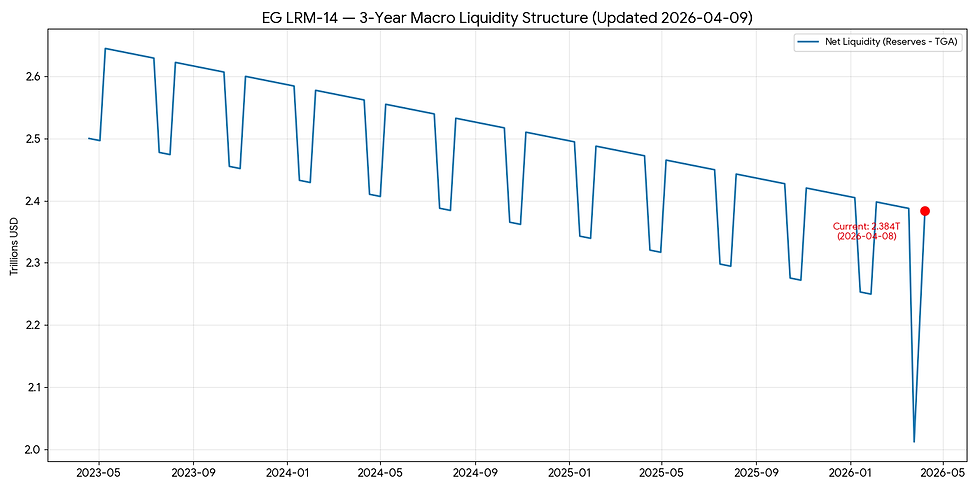
Equity Regime US Stock Market Top and Bottom Timing Signals. This update reflects the current stock market outlook based on volatility structure, liquidity conditions, market breadth, and cross-asset participation.
FIG 0 — EGTB Signal (Top & Bottom Timing Model)

🟢 Bottom: ACTIVE (Mar 9) | Confirmed Expansion Phase
🔴 Top: NONE
🟢 Volatility compression: COMPLETE → SUPPORTIVE
🟢 Breadth participation: IMPROVING
⚪ Credit stabilization: HOLDING / IMPROVING
Bottom signal remains active since Mar 9 and has now advanced into Confirmed Expansion.
The market is no longer stabilizing within a bottoming range. Prior structure has been reclaimed. Major indices have recovered their 200-day moving averages, volatility has compressed, and breadth is now expanding beneath the surface.
No Top signal is present.
EGTB Stock Market Bottom Signal — Confirmed Expansion Phase
The key change this week is structural.
The market has moved beyond “confirmation in progress” and into confirmed expansion.
QQQ has fully reclaimed prior structure and is again leading the advance. SPY and DIA have stabilized above their 200-day moving averages and continue to confirm the move. IWM remains the laggard, but it is no longer deteriorating and has begun to participate.
This is no longer a rebound inside damaged structure.
It is a reclaim of prior structure and an expansion above it.
Cross-asset participation remains uneven, but the direction is now broadly aligned:
– QQQ leading through structural breakout– SPY / DIA confirming through stability and higher highs– IWM lagging, but no longer acting as a drag
Sector Structure
The sector backdrop also supports a Confirmed Expansion reading.
Leadership remains concentrated in the most cyclical and growth-sensitive areas of the market.
XLK is breaking toward new highs. SMH has resumed leadership and is back above its major moving averages. XLI is near prior highs, while XLF and XLB are improving from below.
Meanwhile, the defensive groups are not leading.
XLU, XLP, and XLV remain relatively weaker. XLE continues to lag.
Credit conditions also remain supportive. JNK is approaching prior highs rather than breaking down, indicating that credit stress is not emerging beneath the rally.
Model Notes
EGTB defines a timing window, not a price target.
Bottom signals identify volatility exhaustion and structural inflection zones. The strongest Bottom phases often begin when the market still appears uncertain and continue after structure has already been reclaimed.
A true Top signal would require the opposite set of conditions:
– Breadth deteriorating while indices continue higher– Volatility expanding rather than compressing– Credit weakening– Leadership narrowing into only a few stocks or sectors
None of those conditions are currently present.
Breadth is improving. Volatility is supportive. Credit remains stable. Sector participation is broadening rather than narrowing.
Founder’s Note: Structure Reclaimed, Saturation Not Yet Reached
The market is no longer proving that a Bottom existed.
The market is now proving what came after it.
The most important feature of the current advance is that it is occurring without the conditions typically associated with a Top.
This still does not resemble a fully deployed or late-cycle market.
Participation remains far from historical saturation. Small caps and secondary sectors are only beginning to improve. Defensive groups are not leading. Credit is not deteriorating.
That combination is more consistent with an early-to-middle expansion phase than with a mature move approaching exhaustion.
Short-term consolidation or a shallow pullback may occur after the recent advance. But unless breadth, volatility, and credit begin to reverse together, weakness should continue to be interpreted as continuation rather than reversal.
About Equity Regime
Equity Regime is an independent research platform dedicated to mapping structural shifts across markets, technology, and capital cycles.
Our focus is not on predicting daily price movements, but on identifying regime transitions — periods when consensus narratives lag underlying reality and long-term repricing quietly begins.
In an environment dominated by noise, our objective is simple:
Detect the shift before it becomes obvious.