Equity Regime Macro Research Report: Gold Cycle Intact, Consolidation Phase Building
Abstract
This report assesses gold’s medium-term outlook against a backdrop of shifting reserve preferences, persistent geopolitical risk, and evolving global liquidity conditions. The sustained recovery in the Gold/S&P 500 ratio suggests a relative performance transition in which portfolio allocation is gradually rotating toward hard reserve assets. Recent volatility has been amplified by derivatives positioning and momentum dynamics, yet liquidity indicators point to a re-calibration process rather than a contractionary regime. Within this framework, gold is expected to remain in an intact cyclical uptrend, with the most probable path characterized by a period of time-based consolidation followed by a renewed phase of trend continuation.
I. Macro Regime Shift: Gold’s Monetary Repositioning

The long-term Gold-to-S&P 500 ratio has entered a structural recovery phase following an extended period of relative underperformance. Historical cycle analysis suggests a recurring behavioral pattern in which phases of extreme relative momentum do not coincide with immediate price peaks but instead precede a delayed adjustment process. In prior cycles, gold prices have typically continued advancing for several months after relative momentum extremes before transitioning into consolidation phases lasting between six and twenty-four months, or, in instances associated with secular peaks, extended structural bear markets.
The present cycle does not exhibit characteristics consistent with late-stage secular exhaustion. The Gold/SP ratio remains positioned within a mid-cycle recovery context following a prolonged structural bear market, implying substantial distance from historical valuation extremes. Consequently, elevated momentum conditions should be interpreted primarily as timing signals reflecting approaching volatility normalization rather than trend-reversal triggers. Under this framework, short-term gold price dynamics are expected to remain constructive, yet the probability increases that within the next six to twelve months the market may transition into an intermediate consolidation phase lasting approximately six to eighteen months.
This interpretation reinforces the broader thesis that the ongoing gold advance represents a regime-level rebalancing process rather than a terminal speculative surge, with consolidation phases functioning as slope normalization within a structurally constructive trend.
Recent price volatility should be interpreted within a multi-timeframe context. The latest pullback represents a short-horizon adjustment primarily observable on daily and weekly timeframes, while the monthly structure remains largely unaffected. Such fluctuations are consistent with momentum normalization episodes rather than evidence of a structural reversal, suggesting that the adjustment is best characterized as a minor volatility event within an intact medium-term trend.
II. Liquidity Framework: Re-calibration Without Systemic Contraction

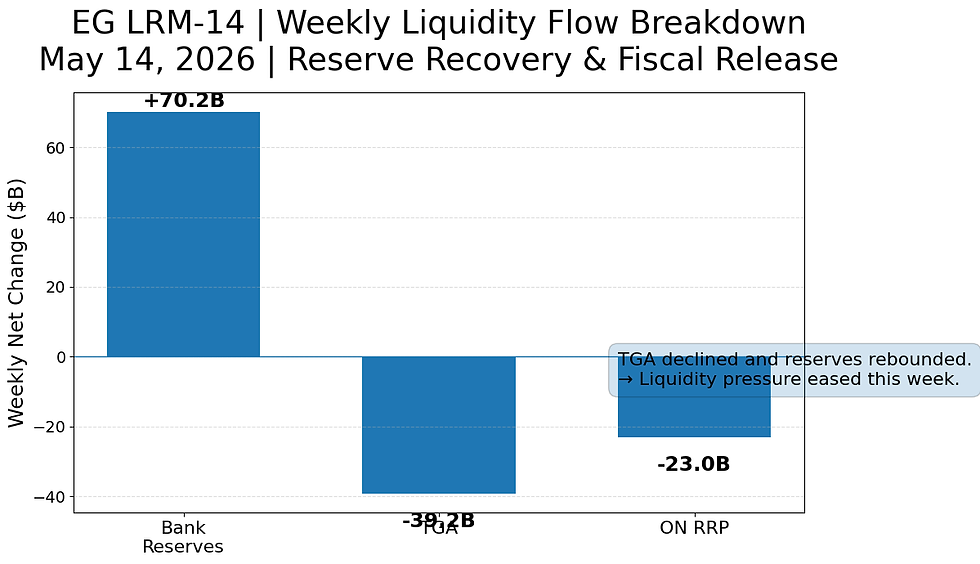
Liquidity telemetry derived from Federal Reserve balance sheet components indicates an ongoing redistribution of buffers rather than a collapse in systemic liquidity. The simultaneous erosion of ON RRP balances and periodic fluctuations in bank reserves increases asset sensitivity to risk premia, supporting gold’s insurance function without signaling imminent financial stress.
Within the EG LRM-14 interpretive framework, the current environment is best characterized as a re-calibration phase with a tightening bias, where liquidity remains structurally supportive but increasingly uneven in transmission. Under these conditions, gold’s allocation appeal is driven primarily by reserve diversification and volatility insurance rather than acute crisis hedging demand.
III. Structural Demand: Official Sector Anchoring
[Insert Figure 3 — Central Banks’ Gold vs US Treasuries as % of Reserves]
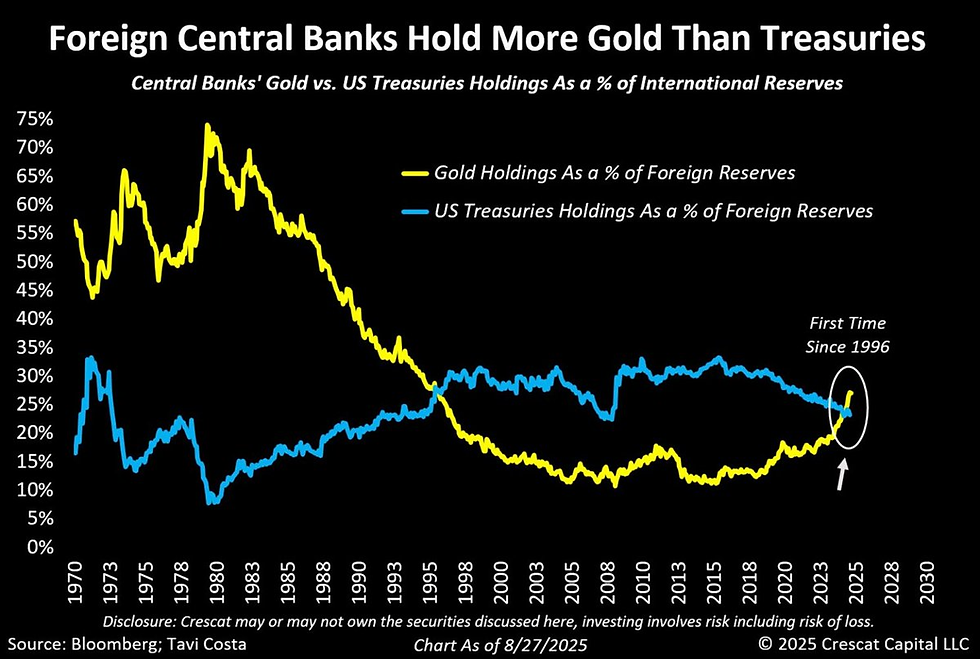
The relative share of gold within foreign reserve portfolios has overtaken US Treasury holdings, signaling a regime-level reassessment of sovereign asset composition driven by sanctions risk, fiscal sustainability concerns, and reserve sovereignty considerations.
Official sector gold accumulation has remained elevated since 2022, reflecting a structural reassessment of reserve composition following geopolitical and financial fragmentation. While recent volatility has temporarily moderated purchasing pace, available evidence suggests this slowdown reflects tactical timing rather than a reversal in strategic intent.
Central banks continue to view gold as a neutral reserve asset capable of mitigating currency concentration risk and geopolitical exposure. Consequently, episodic demand fluctuations are unlikely to alter the broader trajectory of reserve diversification.
IV. Tactical Positioning: Reserve Diversification Acceleration
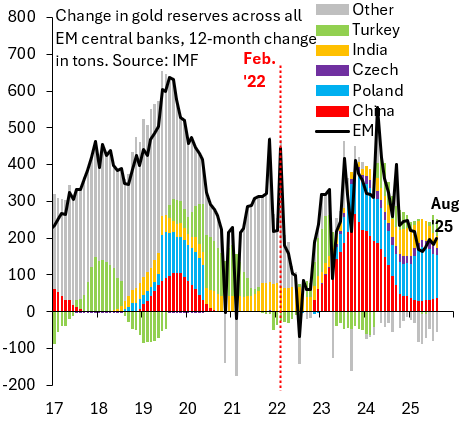
China’s reserve behavior provides an illustrative case of the broader structural diversification trend. The observed increase in gold’s share of total reserves alongside a gradual reduction in non-gold reserve valuation sensitivity indicates an intentional rebalancing strategy designed to mitigate external monetary exposure. This behavior reinforces the thesis that sovereign demand is evolving from opportunistic accumulation toward systematic allocation frameworks.
The interaction between official reserve diversification and private-sector hedging activity has contributed to elevated gold volatility. Options market dynamics, particularly the expansion of call option positioning, have mechanically amplified price movements through dealer hedging flows. While this mechanism increases short-term downside tail risk, it does not undermine the structural demand thesis; instead, it introduces episodic tactical corrections within an otherwise constructive medium-term trajectory.
V. Market Microstructure Overlay
Recent price dynamics reveal increasing influence from derivatives positioning, particularly call option demand that generates mechanical dealer hedging flows. This dynamic amplifies both upward momentum and downside volatility, producing non-linear price paths that may temporarily obscure macro drivers. Elevated volatility can delay central bank purchasing activity due to price sensitivity but does not materially alter structural demand.
VI. Scenario Framework
Base Case (≈60%)Gold maintains a structurally bullish trajectory with intermittent consolidation followed by renewed trend expansion.
Bull Case (≈25%)Accelerated reserve diversification and declining real yields drive stronger momentum expansion.
Bear Case (≈15%)Improved equity earnings and liquidity buffer rebuilding extend consolidation without structural breakdown.
VII. Risk Conditions
The medium-term bullish thesis would face challenge under the following developments:
Sustained rise in real yields
Re-expansion of liquidity buffers
Structural slowdown in central bank accumulation
Renewed equity earnings acceleration
Breakdown of Gold/SPX momentum below long-term trend indicators
Such outcomes would likely result in time-based re-pricing rather than a structural bear market.
VIII. Institutional Verdict
Synthesizing cross-asset dynamics, liquidity telemetry, and reserve behavior, gold appears to be in the early-to-mid phase of a structural reserve re-pricing cycle. Short-term volatility reflects financialization and derivatives-driven amplification rather than macro trend reversal. As global asset allocation transitions toward a multi-anchor framework, gold’s strategic weight within portfolios is expected to increase, with medium-term price trajectories favoring oscillatory upward progression.
IX. Founder’s Note
The current gold cycle represents a transformation in valuation architecture rather than a conventional commodity rally. Decades of sovereign credit dominance within reserve frameworks are gradually giving way to a more diversified system in which hard assets regain strategic relevance. Liquidity conditions remain supportive yet increasingly sensitive to risk premium dynamics, reinforcing gold’s role as structural insurance. The reversal of the Gold/SPX ratio signals a redistribution of pricing authority across asset classes, suggesting that future market debates may center less on directional price targets and more on the evolving balance of reserve composition within the global financial system.
About Equity Regime
Equity Regime is an independent research platform dedicated to mapping structural shifts across markets, technology, and capital cycles.
Our focus is not on predicting daily price movements, but on identifying regime transitions — periods when consensus narratives lag underlying reality and long-term repricing quietly begins.
In an environment dominated by noise, our objective is simple:
Detect the shift before it becomes obvious.