Monthly MACD Bearish Cross — Why It’s Not a Bear Market Trigger

MACD is one of the most widely used technical indicators in the market. Yet it is still frequently misused or misinterpreted.
The following is a response originally published on X, addressing a common misconception: using MACD as a bear market trigger.
This is incorrect — especially when you’re talking about Monthly MACD.
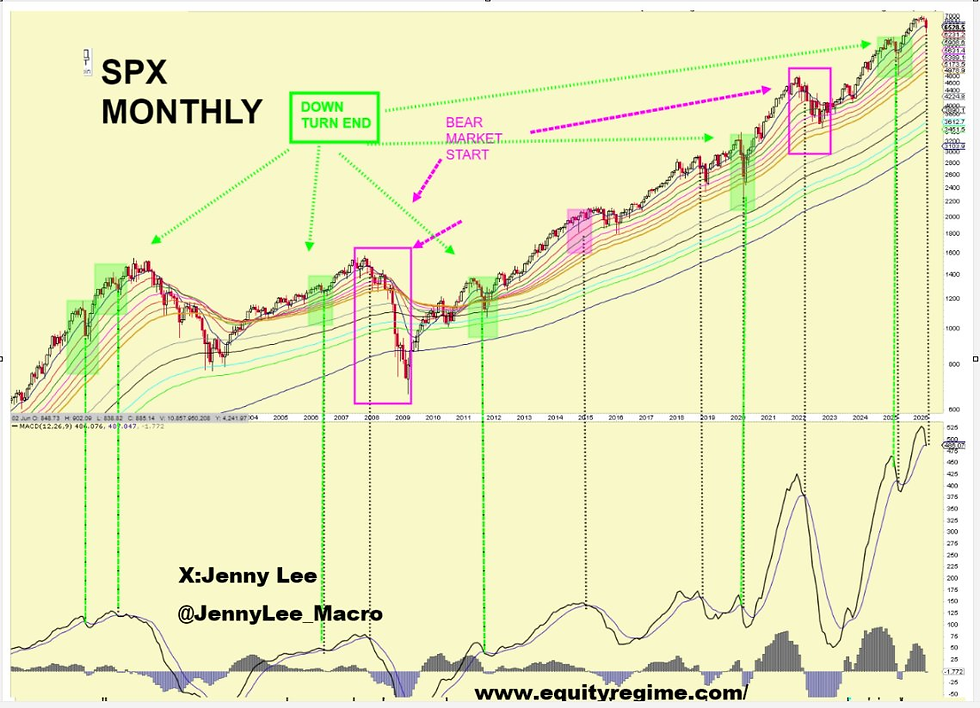
The chart above shows why.
On the monthly timeframe, Monthly MACD is a slow structural indicator. It does not trigger bear markets — it reflects what has already unfolded.
Look at the cycles:
In most corrections (10–20%), price has already declined significantly before the Monthly MACD bearish cross appears. By the time Monthly MACD crosses, the market is already in the lower phase of the move.
In fast drawdowns, the signal compresses. Monthly MACD flips close to exhaustion zones, not at the beginning.
Only in true structural bear markets (2008, 2022), where liquidity is contracting and trend breakdown is persistent, does the Monthly MACD bearish cross occur mid-cycle or early.
That’s the key distinction.
Monthly MACD is not an early warning signal. Monthly MACD is a late-stage confirmation tool, often appearing when most of the damage is already done.
If you treat a Monthly MACD bearish cross as a bear market trigger, you are usually reacting late — not identifying the start.
Conclusion
Indicators do not carry meaning in isolation.
Their interpretation depends on structure, regime, and context.